Projects
Haunted Wires
IA4: Dreams & Echoes
Beachcomber
Mycomythopoeia
Cract!
Parsing Memory
World of Keepers
Time Odyssey
Museum of Imagined Futures
Distant Librarians
In Search of the Strange
Residue
The Pengguling Egg
this place [of mine]
Macabre Mail
Spook_bot
Distant Librarians – Artist residency
Cuneiform crumbles and scatters on the winds of time. Dredged through eras, lost words merge with ghosts and the dust of Victorian buildings. And still we march on, from yellowing pages to shimmering screens, knotted oak shelves to vacant white walls and bright plastic chairs, and the echoes of rhymetime as people chat over their knitting.
Such is the nature of the library. A shapeshifter. A polymorphic symphony of histories and uses, existing in a state of perpetual flow, ever yielding and growing with its community. So much more than the intoxicating magic of books and the written word, the library’s sorcery is in its multiformity. In its ability to mean so many different things to each of us and the communities we’re part of. This multiplicity is what I wanted to explore during my artist residency with Manchester’s inaugural Festival of Libraries – the diverse meaning and potential of libraries, and how this might help us divine their future.
Over the course of several weeks, I worked with a brilliant group of writers from Manchester’s Young Identity. Together, we explored what libraries mean to us – our memories, our experiences, our hopes and ideas for the future. During these sessions, the young writers also created new work – a mix of poetry and short fiction – responding to our discussions, which they performed live at Urmston Library during the Festival.

“A library is a focal point, a sacred place to a community; and its sacredness is its accessibility, its publicness. It’s everybody’s place.”
― Ursula K. Le Guin
Old haunts and new fictions
During the course of our sessions and the conversations that followed the live event, I found myself – like Ursula K. Le Guin – struck by a sense of the sanctity of libraries. Libraries seem to hold a special status for so many of us. We become, then, custodians of these places – duty bound to protect our libraries from desolation and abandonment. The library is often one of our earliest connections with a world bigger than our own. It can be a portal to another place. A retreat from loneliness. A pathway to our personal history. Or simply a place just to be. Though we often carry this magical feeling with us into adulthood, our later experiences tell another story. One in which the library of our memories – old, dusty, wooden, grand – doesn’t marry up with the libraries of today, with their modernity, technology and bright white walls. We find ourselves struggling to understand our place in this new form.
At the same time, throughout our conversations there was a genuine celebration of the diverse evolution of local libraries, and a commitment to supporting modern libraries in their efforts to better serve the needs of a changing community. And so, there’s a tension. An innate challenge in trying to evolve something so multiform that it can hold equal appeal and meaning for a diverse community, each person with their own memories, wants and needs. Can such a balance be found? Or will one person’s utopia always be someone else’s dystopia?
It’s a strange tension, and one I wanted to explore – albeit in small form – through Old Haunts, a short flash fiction vignette in which someone returns home to find their library changed.
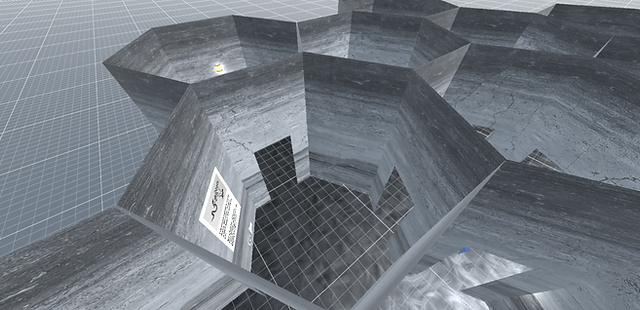
Borgesian hexagonal galleries
“I have always imagined that Paradise will be a kind of library.”
― Jorge Luis Borges
Verse of the distant librarians
During my residency, I also wanted to explore what other people had to say about libraries, from Edward Hirsch’s wistful and nostalgic poem, Branch Library, to In The Stacks, a wonderful anthology of short stories about libraries and librarians, curated by editor Michael Cart. One story that resonated in particular was The Library of Babel, a magical realist short story by author – and, later, director of the National Library of Argentina – Jorge Luis Borges.
In the story, Borges equates the entire universe with a kind of infinite library. One in which there exist infinite texts – every book that has ever been written or could be written. Within this infinite collection there must, then, exist a kind of sacred text, one that could help us unlock some basic truth about the universe and our existence. It is from this story that the notion of the “distant librarians” and “distant libraries” emerged. What if we could mine that infinite library and channel those distant librarians to unearth some truth – or sacred text – about libraries?
As someone with a background in digital storytelling, this got me thinking about artificial intelligence (AI) – specifically generative AI based on language models, such as OpenAI’s GPT-2*. These models are built on huge datasets of written text, which they use to build their own systems of language. These datasets are often very diverse, from great literary works in the public domain, to text scraped from internet chat forums. Just like Borges’ Library of Babel, these models are based on a finite number of letters and glyphs, with which they can generate seemingly infinite possibilities. If we convene with AI, might we also get to convene with those distant librarians? And if so, what would they have to say about libraries?
So, I decided to channel the gods!
Inspired by the themes and conversations that emerged during my sessions with Young Identity, I created a series of short text vignettes. I then fed these into an online AI text synthesiser built on GPT-2. Based on the words, style and nuance of my vignettes, the AI responded in a similar tone, offering up the words and sentences it thought might come next. I generated pages and pages of text in this way, much of it gibberish!
I then took on the role of clairvoyant, sifting through the white noise to discern hidden messages of poetic quality. Before, finally, in the spirit of the Dada poets, I re-interpreted, re-assembled and re-wrote those selected fragments to create something new: a collection of experimental collage poems about libraries and the people who occupy them.
Verse 1
We are children in the library
We push through the doors
take our first breath in the sun of childhood
We are like wind passing through
a dark mass of unkempt trees
to lie where dreams used to roam
We fall asleep in those streets,
with their pavement of books
a stone’s throw from where we should be
And in this old tomb, we wait
and for a hundred years there is no answer
until one day
we become the ghosts of our time
the poems of our time
and the children of today remember everything.
Verse 2
The library is so much larger
than you could believe
The only place where you can still listen to people’s thoughts,
still enjoy what they might call “wasted time”.
The library is a city without walls
A huge cathedral
A small sanctuary,
dark and full of magic.
The library is ashes on a piano
while the choir sings
And you holding your daughter’s hand,
her skin like lemon and red rose
All of these images seem to combine
to make something
of the library,
to make something of us.
Verse 3
It rained the library yesterday
drip by drip
from the stacks
of the long since dead
tomes strewn about the floor
in runic puddles.
I built a home
from those stacks
took the books and
pulled them over my head
in a broken tower
lit brighter than a neon sign.
Verse 4
He was a good reader,
wanted to know
not just the words,
but the stories
that filled the pages.
His books lay on the sidewalk,
congregated with the other boys
like new friends,
but he made no move
that librarian,
the person we most wanted to talk to.
This work was created during my Writer/Artist residency with Manchester City of Literature’s inaugural Festival of Libraries. With thanks to Trafford Libraries for hosting the residency, and to writers Lauren, Esther, Louis, Jova, Kayleigh and Louise at Young Identity for being such a source of inspiration. Additional thanks to Lynda Clark for guidance around AI writing.
*Note: at the time of making this project, language-based AIs were extremely janky! For me, this is what gave them a certain charm and allure as a writing partner – their capacity for mistakes, spontaneity, surreality – not the “polished” versions of AI writing companions we have today.
 Michelle Collier | Writer, Artist, Narrative Designer